|
|
|
|
|
 |
|
 |
 |

• . Divine /Prophesy .. Divination (div’i·nā’shen), n. [OF., fr. L. divinatio, fr. divinare, -natum, to
foresee, foretell, fr. divinus.divine.]
1.
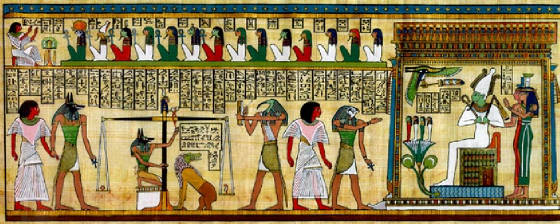
the act or practice of or foreseeing
or foretelling future events discovering
hidden knowledge. 2. Augury, omen; also, prediction.
3.
Exercise of intuition; also an intuitive perception. Syn. Discernment . Diviner – One who divines Divinity – the Science of divine things. . Prophesy (prof’ë·sī) v.t.; sied, sy’ing. 1. to utter with or as with divine inspiration. 2.
To predict; foretell. 3. Rare. To foreshow. –v.i. a.
To speak under the influence of religious experience, and hence as divinely inspired. Ezek. xxxviii.7.
b. To give instructions in religious matters. c. To utter predictions.
Prophecy (prof’ë·s) n.; pl. –CIES.
[OF. prophecie, fr. LL. prophetia, fr. Gr. prophetia, fr. prophetes, prophet] 1. The work or vocation of a prophet, utterance
of a prophet. 2. a Declaration of something to come; prediction. Prophetic (pro·fet’ik),
adj. Of or pertaining to a Prophet or
prophecy; interpretative; foretelling events.
|
|
| Religious Dogma MUST DIE... |
|
| In Order For Humanity to Live. |
Click PX to Order

|
THIS PAGE NAVIGATION:
.
. “Man is not far enough advanced to
live by faith. He cannot comprehend the things his eyes see not.” He
yet is child; and during
all the coming age must be taught by pictures, symbols, rites and forms."
.
.
“And man cannot originate.
He builds by patterns that he can see. So, in this council, we must carve out patterns for the coming age. And we must formulate the gnosis of the empire of the soul which rests on
seven.” .
. 
Beginning Of Christianity
Chapter 46 of Circle 7 1 Page PDF
. . Religious Controversy From
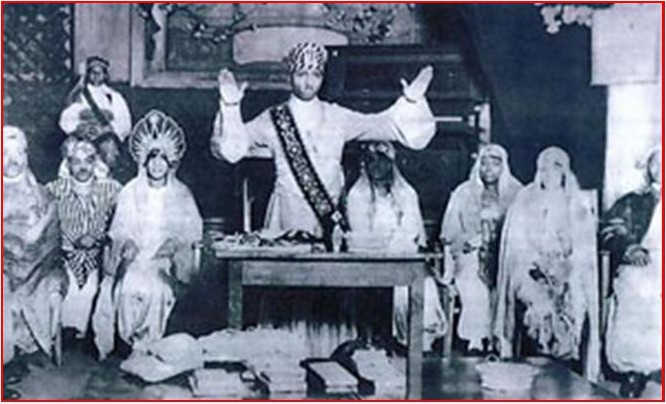
'Moorish Literature' - Noble Drew Ali .
In this age there is still much religious controversy as to the right thing. .
Big and powerful ministers have come to the conclusion that something is wrong. Some say it is the Ten Commandments,
others say there is a lack of sincerity in the purpose of the churches; still others think it is all worthless and not fit
for the time it takes to attend them. However whatever their final decision might be, it is certain they will make a change
or rather try to make one. . The fact of the matter is that they have always had only
a reflection of the truth and not the real thing. Like one who holds up to the sun a mirror and casts a few of its diverted
rays in a different direction, so have they done with the truth that is supposed to have come from the East. .
There are but few people who know what the truth is about man, and that few know that it is foolish to try
to impart it to the ignorant. Although the ignorant has finished college, he is a fool right on, being trained to jump through
a hoop. The longer he stays in the schools, the better he can jump. And the more vivid will he defend his jumping. .
From the East comes all light, but though the sun is hanging at high noon; the blind cannot see. The same is the
Islamic Creed from the East was brought to the Asiatics of America by the Prophet, NOBLE DREW ALI, and offered to those who
were sick at heart, tried for many years, yet they are blind and cannot see the light. Nor is the Prophet trying to put new
wine in old skins, for he knows that it will burst them. Still he has the only remedy for the nations. The remedy brought
by Jesus, Mohammed, Confucius, and all of the other prophets, which remedy is truth. . The nations do not want the
truth; it is too stern, but until they accept it and find out where it is, there will continue to be religious controversy. . --Prophet
Noble Drew Ali . 
Religious Controversy - PDF 1 pg
Listen to this Important Audio Message .
What Is Religion?
.
1. Fiat, Faith And Dyslogistic Families
. Religion
and the Controversies
Surrounding
It - Taj Tarik Bey . The
above - captioned article was written by Noble Drew Ali and later published in the “Moorish Guide Newspaper”
in the year 1929 A.D. The same article was also published in a little booklet of compiled editorials, which was known as, “The
Moorish Literature”. This enlightening collection of articles was commonly distributed among conscious
Moorish Americans. Fortunately, I had the opportunity of acquiring a copy. There is no doubt that the words and statements
made by Him were, and are, very thought – provoking, inspiring, and compelling. Upon having the beneficial
opportunity to read this particular article on ‘Religious Controversy’ in the year 1977 A.D., I was definitively
moved to examine the issue and to study its directives. I did not originally seek to prove or disprove
any points made therein, nor did I seek to confirm them either. Interesting enough, as divine fate would have it, I was assuredly
surprised and enlightened on a continuous basis as my studies on religion progressed. I came to recognize
and realize that ‘Religion’ was indeed not what I had been taught that it was by teachers and preachers by whom
I had, as others, been influenced. And then again, not unlike anyone else who has experienced what may
be called, “a rude awakening”, I, too, discovered myself being shown by a caring and loving will of mind, a path
that placed me on a journey for greater and more profound truths.
Upon re-looking and rereading many books and texts of which I had previously become somewhat familiar,
I quickly began to see and acknowledge new (though old) concepts about religion and philosophy. A shortened and abbreviated
list of some of the books and literature that improved my capacity to gain more in - depth understandings about the nature,
character, functions, and origins of original ancient religion, are listed below. .
An Abbreviated Book List:
1. Two versions of Septuagint. 2. The Torah. 3. A number of older Bibles. 4. A few versions of the
Holy Koran. 5. The Circle 7
Koran. 6. Multiple sets of old Encyclopedias. 7. Numerous older History
books. 8.
Numerous
older Unabridged Dictionaries. 9. A Variety of Etymology
Dictionaries. 10. A few Latin to English Dictionaries. 11. A couple of Hebrew to
English Dictionaries. 12. The Egyptian Book of the Dead. 13. Some Advanced Yoga Lesson books. 14. Ancient Philosophies. 15. The Moorish Empire – 18th Century Books. 16. African Religions. 17. The Kabala. 18. The Kybalion. 19. Books on Hindustani History and Philosophy. 20. The Maurian Dynasty in Perot/Hindustan (Also Nanda /Gupta) 21. Buddhist texts. 22. Studies of Confucius. 23. Studies
on Ancient Central American Culture. 24. Cosmology. 25. Astrology and other
Ancient Eastern Culture Philosophies, etc. 26. Metu Neter. 27. The Vedas. 28. Multiple Law Dictionaries of Ancient & Modern Jurisprudence, etc. .
Logically, these above - listed books represent only
a small number of the books and avenues of readings which certainly proved useful in research and study, but they are definitely
not the limit. One thing, however, is sure. One’s concepts will broaden and change to a more positive
and grounded perspective on religion. Naivety will no longer find comfort with a thinking, rational, and reasoning human being.
Knowledge dispels a need for blind faith and unfounded beliefs. There are a few points that can be said concerning
the truth of ancient religions, and that is the fact they all, in identifiable forms and symbolisms, are rooted in Astrology
and cosmology. The capacity of scholars or neophytes to accept those truths is limited to their inclinations, or lack thereof,
to be willing and able to change their outlooks or positions on the subject of religion, once exposed to fundamental and primal
truths.
. As for an opinion
or suggestion, as coming from me to others, I would say, “Study for yourselves, and take responsibility for
your own will and capacity to handle, accept, support, and defend truth.” Everyone is, unto themselves,
the torch - bearers of their own levels of sincerity. Truth may not, and does not, always conform to what one may expect to
find or uncover. Truth is simply what it is, and that it is. However, the past and present social and political conditions
of the humans on the planet would be profoundly improved and advanced, if the masses were to be availed a true, proper and
honorable exposure to Ancient Philosophies, Cosmology, and High Elementary Culture. Extremely progressive possibilities await
the natural peoples of the earth if conditions arise that manifest an absence of fraudulent forced – servitude and control
agendas, sectarianism, and traditional propagated dogmatism. It is an interesting anomaly, however, to
observe the tendencies of the many who have uncovered ancient truths, to see some cringe at the prospects of having to admit
the falsehoods and lies, which they had cherished for so many years! The wonders of revelation are sometimes the windows of
observation to our own inconsistencies to support veracity. Particularly when reality appears to spoil our comforts in our
proven collective affinities to ignorance and meanness. And so, our studies continue with the hopes that we, as the
assumed specie of a stronger intelligence and will, can rise to the occasion of love and progress. -
Peace, Bro. Taj ..
For More Regarding
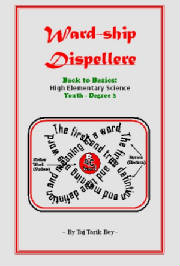
Religion. Read "Wardship Dispellere" by Taj Tarik Bey. .
Religion as we know it, must die in order for humanity to live. Truth conjoined with un-coerced studies or observations of a thing, a place,
a subject matter, a people, or a social condition etc, can, and will reveal many overlooked aspects about the same. Some positive,
some negative. Nonetheless, the social, spiritual, mental and economic injuries and problems, caused by Colonialism and Inquisitionist
practices, are sorely apparent. The genocidal and conquest policies initiated by Demo-Colonists against all Aboriginal and
Indigenous Natural Peoples – all over the world – can be more clearly observed, addressed and analyzed through
the often deliberately overlooked aspects of History, Geography, Jurisprudence, Anthropology and Grammatication. . Click Px for Cart
Mysteries of the Secret Brotherhood of the East
. Chapter VIII THE COUNCIL OF THE SEVEN OF THE WORLD .
1. In every age since time began, but seven sages lived. 2. At first of every age these sages meet
to note the course of nations, people, tribes and tongues, 3. To note how far towards Justice and love
the race has gone; 4. To formulate the code of law, religious postulates and plans of rule best suited
to the coming age. 5. An age had passed, and lo, another age had come. The sages
must convene. 6. Now Alexandria was the center of the world’s best thought; and here in Philo’s
home the sages met. 7. From China came Mengste; from India Vidyapati came; from Persia Kasper came; and from Assyria Ashbina came; from Greece Apollo came; Matheno was the Egyptian sage, and Philo was the chief of Hebrew thought. 8. The time was due. The
council met and sat in silence seven days. 9. And the Mengste rose and said, “The
wheel of time has turned once more.
The race is on a higher plane of thought. 10. The garments that our fathers wore have given out. The cherubim have woven a celestial
cloth, have placed
it in our hands; and we must make for men new garbs. 11. The sons of men are looking up for greater light.
No longer do they care for gods hewn out of wood. They seek for Allah not made with hands.
12. They see the beams of coming days, and yet comprehend
them not.
13. The
time is ripe. And we must fashion well these garments for the race.
14. And let us make for men new garbs of Justice Mercy and Love, that they may hide their nakedness when shines the light of coming days.” 15. And Vidyapati said, “Our priests
have all gone mad. They saw a demon in the wilds, and at him cast their lamps, and they are broken up, and not a gleam of light has any priest for men.” 16. “The night is
dark. The heart of India calls for light.” 17. “The priest-hood cannot be reformed; it is already dead; its greatest needs are graves and funeral chants.” 18. “The new age
calls for liberty—the kind that makes each man a priest; enables him to go alone and lay his offerings on the Shrine of Allah.” 19. And Kaspar said, “In Persia people walk
in fear. They do the good for fear to do the wrong.” 20. “The devil is the greatest power in our land.
And, through a myth, he dandles on his knees both youth
and age.” 21. “Our land is dark; and evil prospers in the dark.” 22. “Fear rides on every passing breeze, and lurks in every form of life.” 23. “The fear of evil is a myth; is an illusion and snare; but it will
live until some mighty power shall come to raise the ethers
to the plane of light.” 24.. “When this shall come to pass, the Magian land will glory in the light. The
soul of Persia calls for Light.” . . Chapter IX OPENING ADDRESS OF YEHOSHUA WITH THE SEVEN SAGES—SEVEN DAYS SILENCE. . 1. Ashbina said, “Assyria is the land
of doubt. The chariot of my people that in which they mostly ride is labeled, ‘DOUBT”. 2. “Once Faith walked in Babylon and she was bright and fair; but she was clothed in such white robes that men became afraid
of her.” 3. “And every wheel began to turn; and doubt made war on her and drove her
from the land, and she came back no more.” 4. “In form man worships Allah, the one; in heart they are not sure that Allah exists.” 5. “Faith worships at the Temple of one not seen; but doubt must see her
god.” 6. “The greatest needs of all Assyria is faith; a faith
that seasons everything that is with certainty.” 7. And then Apollo said, “The
greatest needs of Greece are true conceptions of Allah the one.” 8. “In
Greece, it is rudderless for every thought may be a god to worship as Allah. 9. “The
plane of thought is broad, and full of sharp antagonists. And so the circle of the gods is filled with enmity, with wars and base intrigues.” 10. “Greece needs a master-mind to stand
above the gods; to raise the mind of men away from many gods to Allah the one.” 11. “We know the light is coming over
the hills—Allah speed the light. 12. Matheno said, “Behold this land
of Egypt of the dead.” 13. “Our Temples
long have been the tombs of hidden things of time. Our Temple crypts and caves are dark.” 14. “In
light there is no secret things. The sun reveals all hidden truth. There are no mysteries in Allah.”
15. “Behold the rising sun.
His beams are entering every door; yes; every crevice of the mystic crypts of Mizraim.”
16. “We hail the light. All Egypt craves the light.” 17. And Philo said, “The need of Hebrew thought and life is Liberty.” 18. “The Hebrew Prophets, seers and givers of the law were men of power, men of holy thought; and they bequeathed to us a system of love that was ideal; one strong enough to lead our people to the goal of perfectness.” 19. “But
carnal minds repudiated this law of love, and filled the minds with selfishness. And purity in heart became a myth. The people were enslaved.”
20. “But when
he comes who is to come, he will proclaim emancipation for the slaves. My people will be free.” 21.
“Behold, for Allah has made incarnate, wisdom, love and light
which he called Immanuel.” 22.
“To him is given the key to open up the dawn. And
here as man he walked with us.” 23.
"And then the council chamber door was opened; and the Logos
stood among the sages of the
world.” 24.
Again the sages sat in silence seven days. .
Chapter X MEETING OF THE SEVEN SAGES
TO MAKE LAWS FOR THE COMING AGE FOR THE NATIONS OF THE EARTH. Now when the sages
were refreshed, they opened up the book of life
and read. . . 1. They read the story of the life of man; of all his struggles, losses and gains, and in the light of
past events and deeds, they saw what would be best
for him in coming years. 2. They knew the kind of law and precepts
suited to his estate. They saw the highest Allah-Ideal that the race could comprehend. 3. Upon the seven postulates these sages were to formulate the law of life of the coming age that souls may rest. 4. Now Mengste was the oldest sage. He took the chair of chief, and said, 5. “Man is not far enough advanced to live by faith. He
cannot comprehend the things his eyes see not.” 6. “He yet is child; and during all the coming age must
be taught by pictures, symbols, rites and forms.’ 7. “His God must be a human God. He cannot see Allah by faith.” 8. “And he cannot rule himself. The king must rule, the man must serve.” 9. “The age that follows this will be the age of man—the age of faith.” 10. “In that blest age the human race will see without
the aid of carnal eyes; will hear the soundless sound, will know the Spirit-Allah.” 11. “The age we enter is the preparation age; and all the schools must
be designed in a simple way that
men may comprehend.” 12. “And man cannot originate.
He builds by patterns that he can see. So, in this council, we must carve out patterns for the coming age.” 13. “And we must formulate the gnosis of the empire of the soul which rests on seven.”
14. “Each
sage, in turn, shall form a postulate; and these shall be the basis of the creeds of men until the perfect age shall come.” .
15. Then Mengste wrote the first. 16. “All things are thought; all life is thought-activity.
The multitudes of beings are but phases of the one great thought made manifest. Lo, Allah is thought,
and thought is Allah.” .
17. Then Vidyapati wrote the second postulate. 18. “Eternal thought is one. In
essence it is two — intelligence and force; and, when they breathe a child is born; this child is Love.” 19. “And thus the Triune Allah stands forth, whom men call father, mother, son.” 20. “This
Triune Allah is one; but like the one of light, in essence he is seven.” 21. “And
when the Triune Allah breathes forth, lo, seven spirits stand before his face. These are Creative attributes.” 22. “Men call them lesser gods, and in their image they made man.” . 23. And Kaspar wrote the third. 24. “Man was a thought
of Allah formed in the image of the Septonate, clothed in the substance of soul.” 25.
“And his desires were strong. He sought
to manifest on every plane of life. And for himself he made a body of the ethers of the earthy forms; and so he descended
to the plane of earth.” 26. “In this descent he lost his birth-right, lost
his harmony with Allah, made discordant all the notes of life.”
27. “Inharmony and evil are the same. So evil is the hand-work of man.” .
28. Ashbina wrote the fourth. 29. “Seeds do not germinate in light. They do not grow until they find the soil an hide themselves away from light.” 30. “Man
was evolved a seed of everlasting life; but in the ethers of the Triune Allah, the light was far too great for seeds to grow.” 31. “And so man sought the soil
of carnal life; and in the darksomeness of earth he found a place where he could germinate and grow.” 32. “The seed has taken root and grown
full well.”
33. “The
tree of life is rising from the soil of earthy things, and, under natural, law, is reaching up to perfect form.” 34. “There are no supernatural acts of Allah to lift a man from carnal life
to spirit blessedness.
He grows as grows the plant; and, in due time is perfected.” 35. “The
quality of soul that makes it possible for man to rise to spirit life is purity. .
 . Philosophy is the love, the study
or the pursuit of wisdom, or of knowledge of things and of their causes, etc.
This consciously assenting attribute applies to critical analysis and examinations whether the subject or matter is theoretical
or practical. Being a cornerstone of Ancient Moabite / Moorish culture, Philosophy was generally introduced to Neophytes with
a structured study of the Seven Liberal arts, and was categorized into three branches: . 1. Natural Philosophy: is the knowledge and study of natural things, objects, and
phenomena, which is called ‘Science’.
2. Moral Philosophy: is the knowledge
and study of human conduct and actions, which are referred to as, ‘Ethics’. 3. Metaphysical Philosophy: is the knowledge and study that involves natural
reasoning and deals with ultimate reality and with the most general causes of things. This is in contrast with revealed knowledge.
Thus, the rational analysis of the incorporeal and of transcendental and abstract thinking. the study of the Divine
and Natural Law of ‘Cause and Effect’.
In this Treatise we are presenting basic ancient
historical and philosophical truths that are fundamental to Civilization. These Primal, High
- truth Culture Principles have heavily influenced all modern organized religions, yet have lacked proper observance and recognition.
The reason that these Principles are not commonly known by the masses is due to Inquisition book – burnings and other
forms of mass destruction, ordered by the Popes of Rome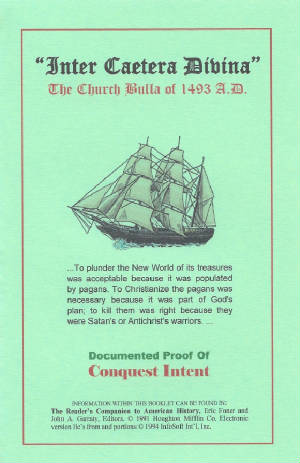 . (Review ‘Inter Caetera Divina’ Bulla of 1493 A.D.). Note the deliberately orchestrated miseducation, initiated
for conquest, theft, genocide, and control purposes. Other elements of primal Ancient Philosophy have also become distorted
and misrepresented by the unclean hands of (less than honorable persons) whose desires (duplicitous of Rome) are to control,
rob, and deceive people. Many Historians, Anthropologists, Sociologists and Pseudo-Religionists are politically compromised
and with forethought, would rather be the hypocrite than to admit their contemporarily - flawed and altered versions and distortions
of the Cosmology Culture originating with the Ancient Ones. . (Review ‘Inter Caetera Divina’ Bulla of 1493 A.D.). Note the deliberately orchestrated miseducation, initiated
for conquest, theft, genocide, and control purposes. Other elements of primal Ancient Philosophy have also become distorted
and misrepresented by the unclean hands of (less than honorable persons) whose desires (duplicitous of Rome) are to control,
rob, and deceive people. Many Historians, Anthropologists, Sociologists and Pseudo-Religionists are politically compromised
and with forethought, would rather be the hypocrite than to admit their contemporarily - flawed and altered versions and distortions
of the Cosmology Culture originating with the Ancient Ones.
Let us examine the following texts and observe the origins of what many people of today refer to as, Deity.
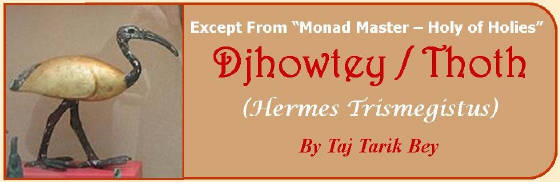
Djhowtey and Thoth, and Tehuti, and Hermes are one and the same.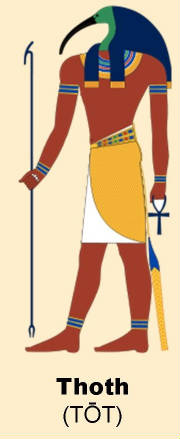 Most students of history and Philosophy are more familiar with the name, Hermes.
However, we must always remember the origin of the name and of its primal connection to Djhowtey. And so, in reference
to this Treatise, which is about ‘Divine and Spiritual Philosophy’, we are addressing a primal part of that Ancient
‘Djhowtey Philosophy’ by way of the ‘Djhowtey / Deity’ name--Hermes. Keep that in mind, as we advance
in our future analysis of fundamental Cosmology Principles, that they are embodied within true Ancient Religion, which is
a study of the Universe. Such studies involve all the planetary elliptical aspects, connecting influences, and relative affectations
on Human existence and character developments. Upon this basis of mathematics and calculus, conjoined with the Philosophy
of its informational dispensations, comes the rooted association of ‘Deity’ and the collective, united, forces
of Nature, concluding to the principle of Monotheism, a ‘Oneness’ or ‘Holistic’ view of the Cosmos
or the expanded application of Djhowtey / Deity; representing the Sun Deity, Re, on Earth. Most students of history and Philosophy are more familiar with the name, Hermes.
However, we must always remember the origin of the name and of its primal connection to Djhowtey. And so, in reference
to this Treatise, which is about ‘Divine and Spiritual Philosophy’, we are addressing a primal part of that Ancient
‘Djhowtey Philosophy’ by way of the ‘Djhowtey / Deity’ name--Hermes. Keep that in mind, as we advance
in our future analysis of fundamental Cosmology Principles, that they are embodied within true Ancient Religion, which is
a study of the Universe. Such studies involve all the planetary elliptical aspects, connecting influences, and relative affectations
on Human existence and character developments. Upon this basis of mathematics and calculus, conjoined with the Philosophy
of its informational dispensations, comes the rooted association of ‘Deity’ and the collective, united, forces
of Nature, concluding to the principle of Monotheism, a ‘Oneness’ or ‘Holistic’ view of the Cosmos
or the expanded application of Djhowtey / Deity; representing the Sun Deity, Re, on Earth. Consequently,
the Ancient Ones were never confused about the truth of Djhowtey (Deity) and
were, thusly, Gnostics (meaning those who have knowledge), and not mere pseudo-religious believers in vague personifications
of the forces and their influences. The Ancients knew by way of mathematical calculations and rational thinking, the moral
truths and order of the heavens, as expressed through ‘Divine Law’ or ‘Nature’s Law’.
And so, Hermetic students of Philosophy must be astutely clear that the contemporary religious concepts (promoting the belief
that the word, God and the word, Deity are synonyms) are definitely invalid and misleading. Djhowtey
/ Hermes was also associated with the high culture principles
of Civilization, Philology (the love of learning), was the inventor of writing, and of natural healing. Djhowtey’s sacred
(secret) animals were represented by the Ibis, or by a Baboon depicted with the head of a Dog.
Djhowtey / Thoth was depicted or symbolized in Kamaatan (Egyptian) Cosmology
as a Man, having the Head of an Ibis or a Dog. Djhowtey was also called, Tehuti. Now, let us review the nature and characteristics
of the “Hermetic Principles” that corroborates Ancient Kamaatan Religious / Cosmology Culture. Note: There are Seven (7) Hermetic Principles that have been taught to the Adepts of the Ancient Mystery
Schools of Egypt. These Seven (7) Principles are the basis of Occultism, and the “Keys to all Phenomena”.
Phenomena relates to that Ancient Moabite / Moorish Culture and school of Philosophy that stands on the principle that the
study of Nature is done rightly through examining the factual information, as derived from measurements and measuring and
unbiased statistics. The Philosophical tools, anciently presented by the Moabite / Moors, for Earth – Measure, (Geometry)
are symbolized by the “Compass and the Square”. This symbol is archaically called, Isonomi or Isonomy. Nature
hides in Her bosom the greatest secrets of life; and the one who applies the
instructions they give, can read Her like an open book. Thus, the veils or secret truths and messages codified within
the Torah, The Septuagint, The Bible, The Holy Koran, The Vedas, Upanishads, etc., become unveiled, and reveal themselves
as having origin from a common root of knowledge – namely Cosmology Science Philosophy and Culture. For these texts
are all derivative, in some form, and coming down from the Ancient of Ancients Occult Teachings of the Ages – the Philosophies
of the Ancient Ones. “Veiled Truths” are sometimes relegated (by the uninformed) to mere contemporary misconceptions,
entrusted to the contrary nature, are reflected in the commonly accepted social states of religion. This involves a
definitive “lack of understanding”. Thus, the advent of the intellectual or spiritually – inspired
condition of being ‘blind’ or referencing an existing state of spiritual ‘blindness’. Learn
these Ancient ‘Precepts’ and clear away much of the designed confusion
that has muddied the spiritual paths of the masses, due to institutionalized Dogmatism and its favored companions, Misunderstanding,
Superstition, and Vagueness. Mastering these Seven Hermetic
Precepts is 'Key' for the Neophyte, Scholar, or Adept, to unveil the sacred concepts in Ancient
Philosophy and Religion. Thus, the Hermetic Principles are primal for those who walk the path of Humanitarian Progressions
and Spiritual Ascension. The application of these 7 Precepts constitutes what is referred to as, applying the 'Master
Keys' to open the doors to all knowledge (Gna / Gnosis). . .
. The Seven Hermetic Principles 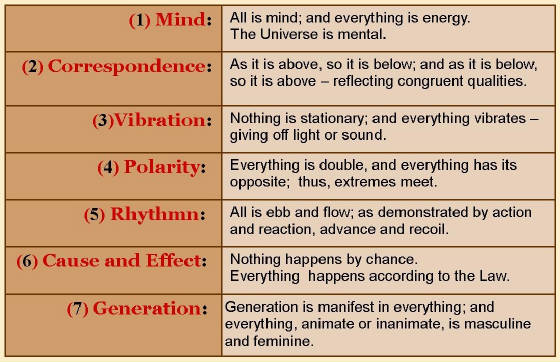 .
Djhowtey (deow-at-ee) is
the Kamaatan (Kemet / Egypt) name of the Guardian, Ruler, and Invoker of the Moon. Thus, Djhowtey is the origin
and advent of the word, Deity. Thoth and Hermes are other names, later given to Djhowtey. Therefore, Adepts,
Scholars, and Neophytes should be made aware of the linguistic fact that when one references Thoth and Hermes, they are giving
testimony to Djhowtey / Deity / Tehuti. The Kamaatan (Kemet) Djhowtey (Deity) Tehuti and the names, Hermes
/ Hermetica / Hermes Trismegistus (Hermes, the Thrice-Greatest) are all related to, and are the Greek transliterated name
for the Kamaatan (Kemetan) Deity, Tehuti, Thoth. Modern and contemporary Historians and Scholars may not
choose to display the truth of the redundant and varied linguistic forms applied to Djhowtey / Tehuti / Deity, because a logistical
approach to analysis of the modernly-recognized word, Deity would prove their contemporary forms of religion as ‘derivative’
as well as being distorted.
Thoth and Hermes (being Djhowtey) is the Ancient of Ancients’ legendary
Author of the Works and Sciences, embodying the Magical, Astrological, and Alchemic disciplines. Thoth is also the Deity that
serves as the Herald and Messenger of the other Deities. Thoth (Hermes) is related to, and concerned with the Theology and
Philosophies of Ancient World Civilizations. Hermetism was extensively cultivated and spread throughout the known world by
the Moors. It was through the Moorish / Moslem Philosophers, Adepts and Scholars, that Hermetic Philosophy reached the Roman
/ European nations in the late, Medieval Period and thusly, by way of Renaissance literature. 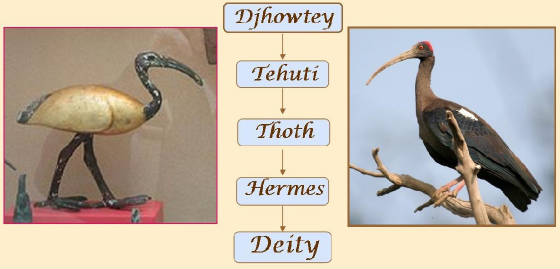
.
. Compliments: “Moors Order Of The Roundtable"
Northwest Amexem /
North America / The North Gate .
.
Back To Top Of Page
Back To Home Page
Back To RVBeyonline Home Page
|
|
|
|
|
|
 |
|
|
|
|
|
|
|
|
|
|
|